Blog · exam prep
Studying for the VTS(ECC) Exam: A Blueprint-First Plan
The VTS(ECC) exam publishes its own study map — the domain blueprint. How to weight your hours, choose materials, and build a study plan that matches it.
Published
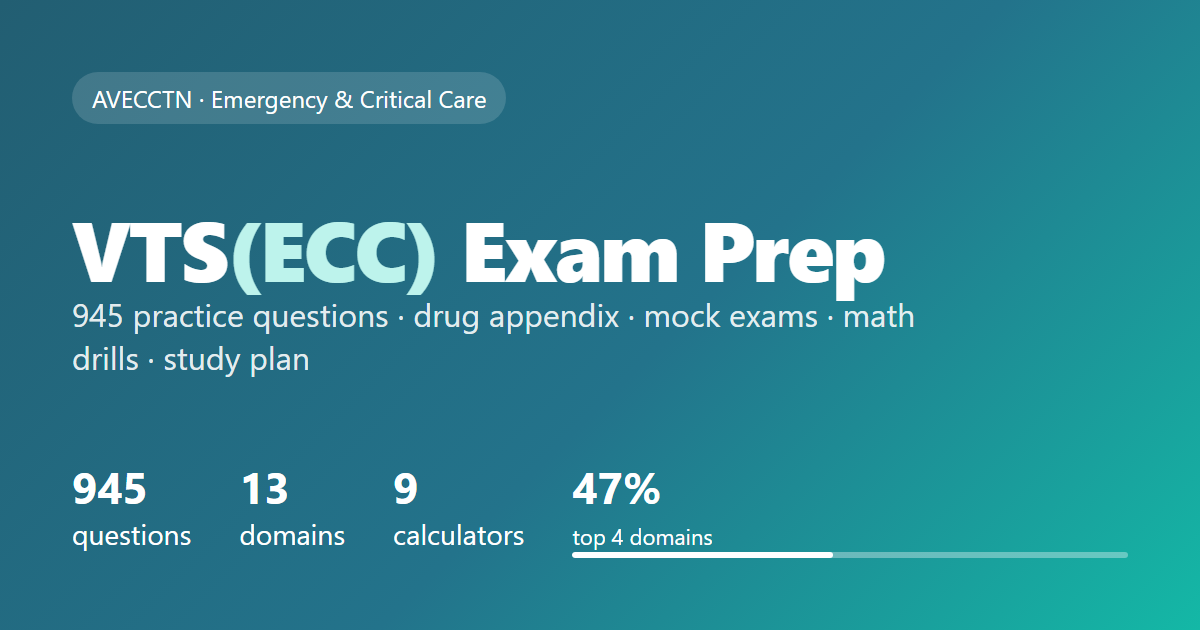
Every year, VTS(ECC) candidates make the same expensive mistake: they study the topics they like, at the depth they enjoy, in the order their textbooks present them. Then they meet an exam that was never organized that way. The exam is organized by its published content outline — the blueprint — and the blueprint should be the spine of your entire study plan.
What is the VTS(ECC) exam blueprint?
The Academy publishes a content outline that breaks the exam into thirteen domains — the major organ systems and practice areas of emergency and critical care — and assigns each a weight. The domains span cardiovascular emergencies, respiratory and airway management, fluid, electrolyte and acid-base disorders, gastrointestinal emergencies, trauma, toxicology, transfusion medicine, analgesia and anesthesia, and more.
Those weights are not decorative. A heavily weighted domain can carry several times the questions of a lightly weighted one. Which means an hour spent on a top-weight domain simply buys you more expected marks than an hour anywhere else.
How should you split your study hours?
The uncomfortable arithmetic of a weighted exam:
- Rank the domains by published weight and portion your calendar to match — heaviest domains first and most often.
- Start with the big four. In the published outline, cardiovascular, gastrointestinal, fluid/electrolyte/acid-base, and respiratory sit at the top. Deep competence there moves your score more than perfection anywhere else.
- Return in cycles, not blocks. One pass through a domain in March that you never revisit is gone by September. Short, repeated passes with practice questions between them are what survive to exam day.
- Let your error rate reassign your hours. Wherever your practice-question accuracy is lowest in a heavy domain, that is your next study block. Feelings lie about readiness; scores do not.
- Do not wait to start studying. Begin your studies alongside your skill and case collection — the theoretical knowledge is just as important as the physical portion. If you are learning and reinforcing the theory while you are putting that same knowledge into physical practice, you are far more likely to retain it — especially if you start early.
Do practice questions actually help?
Yes — and the evidence on this is unusually clear. Retrieval practice (answering questions and checking rationales) consistently outperforms re-reading and highlighting for long-term retention. For a breadth exam like the VTS(ECC), questions do three jobs at once: they force recall, they expose weak domains honestly, and they train the format — reading a stem, eliminating distractors, committing under time pressure.
The catch is that generic vet-tech questions won't map to this exam's blueprint. That mapping is the whole point of this site's practice bank: every question is tagged to its blueprint domain, the bank's proportions mirror the published weights, and each answer carries a rationale tied back to the standard texts. The study plan sequences the domains by weight for you, and the drug appendix and math drills cover the calculation and pharmacology questions candidates most often lose.
What materials do you actually need?
Fewer than you think, used harder than most people use them:
- The standard ECC textbooks — the recognized references for the field (Silverstein & Hopper's Small Animal Critical Care Medicine chief among them). Exam answers trace back to these pages.
- The published content outline — printed, on your wall, driving the calendar.
- A question bank weighted to that outline — for retrieval practice and honest self-assessment.
- A case-discussion habit — talking through your real patients against the textbook standard is free studying, and it doubles as case-log material.
When should you start?
Work backward from a September exam. Most successful candidates describe 6–12 months of deliberate studying, layered on top of the application year itself. A realistic shape: blueprint-ranked reading through the fall and winter, question-driven review through spring, and full mock exams plus weak-domain triage through the summer.
If you can, start a full year out. Not because a year of studying is more studying — because a year of studying is different studying, and it is better in five specific ways:
- You can break the material up instead of compressing it. Thirteen domains across seven reference texts does not fit comfortably into a summer. Spread across a year, each domain gets real depth and a second and third pass, instead of one anxious lap.
- You can follow your clinic instead of fighting it. A year gives you the slack to shift domains toward whatever you are actually seeing on the floor — a run of DKAs, a ventilator patient, a week of tox. Studying the medicine while you are practising it is the single most durable form of retention available to you, and it is free.
- You find your blind spots while there is still time to fix them. Discovering in July that acid–base is your weakest heavy domain is a crisis. Discovering it in November is a study plan.
- You can build a long-term plan rather than a countdown. Cycles, spaced review, and honest weak-domain triage all need runway. Cramming has none, which is why it produces recall that expires the week after the exam.
- It makes your case reports easier to write — and this is the part candidates underestimate. Your case reports are not transcription. They ask you to explain why a patient progressed or decompensated the way they did, and why the treatments chosen were the right ones. That is theoretical knowledge doing clinical work. Candidates who have already studied the underlying medicine write those reports faster and defend their reasoning more confidently, because they understand the physiology behind the case rather than just the sequence of events in it.
Time your purchase to your exam date
This is worth a moment of arithmetic, because it is easy to get wrong in a way that costs you.
Access passes here are one-time and time-boxed — no subscription, no auto-renew — and the clock starts the day you buy, not the day you start studying. So the right pass is not "the one that looks like the most value," it is the one whose length matches the distance between today and your exam date.
Work backward from exam day:
- About a year out? The 12-month pass covers the whole run-up. This is the position we'd recommend engineering for if you can — see the five reasons above.
- Roughly half a year out? The 6-month pass carries you to exam day without leaving a gap.
- In the final stretch? The 3-month pass is built for exactly that window.
The mistake to avoid is buying far too early — a 12-month pass bought eighteen months out has expired before you sit, and a 3-month pass bought in January is spent long before the September you needed it for. Buy when the remaining runway matches the pass.
One thing that works in your favour if you misjudge it slightly: passes stack. Buying again while one is still active extends your access from the existing expiry rather than restarting the clock, so a little overlap costs you nothing.
If you are still more than a year out, the free sample is the right move for now. Study from your textbooks, start your case collection, and buy your access when the calendar lines up.
Which access pass fits where you are?
The passes differ by depth, not by difficulty. All of them are blueprint-weighted, and all of them carry full rationales.
- 12-Month (Comprehensive) — the one we recommend. The complete question bank plus chapter-by-chapter guides to all seven reading-list textbooks. This is the candidacy-year companion: enough runway to study alongside your case collection, follow your clinic, cycle back through heavy domains, and have the theory already in place when your case reports come due.
- 6-Month (Core+) — a serious half-year run-up. Deeper coverage than a final-stretch review, with mock exams and the study coach, for candidates who have already done their foundational reading and want depth plus honest self-assessment through spring and summer.
- 3-Month (Cram) — final-stretch consolidation. A focused, blueprint-weighted set for candidates who have studied and need a structured last pass with mock exams to triage what is still weak.
If you want to feel the blueprint-first approach before committing to anything, create a free account and work the 25-question sample — it is drawn from the same weighted bank, with the same textbook-anchored rationales.
This site is an independent study resource and is not affiliated with, or endorsed by, NAVTA or the AVECCTN. Confirm current exam details in the Academy's official materials.
Sources
- AVECCTN — Examination information (avecct.org)